

- Digital ledger technology encompasses various structures beyond blockchain, affecting finance and applications.
- Blockchain is a specific DLT structure emphasizing security and decentralization, while alternatives like DAG offer scalability.
- Understanding DLT’s architecture and consensus mechanisms is crucial for evaluating crypto projects and managing risks.
Blockchain dominates the headlines, but the technology powering the broader crypto ecosystem is often misunderstood, misnamed, or simply overlooked. Many investors and technologists use “blockchain” and “distributed ledger technology” as if they mean the same thing, but that assumption can lead to costly blind spots when evaluating projects or assessing risk. Digital ledger technology, or DLT, is the wider category that blockchain belongs to, and understanding the distinction matters more than ever as new DLT architectures reshape finance, trading infrastructure, and decentralized applications across the industry.
Table of Contents
Key Takeaways
| Point | Details |
|---|---|
| DLT vs blockchain | Blockchain is a type of DLT, but DLT covers more diverse structures useful in crypto. |
| Consensus matters | How a DLT validates transactions impacts speed, security, and decentralization. |
| Investor benefits | DLT enables more transparent, auditable, and programmable investments for crypto users. |
| Scalability and risks | Scalability, interoperability, and quantum threats remain top challenges for DLT adoption. |
What is digital ledger technology?
DLT is a database technology that records and shares transaction data across multiple locations, called nodes, simultaneously. Unlike a traditional database controlled by a single company or server, DLT requires no central authority. Every participating node holds a copy of the ledger, and any new data must be verified and agreed upon by the network before it is permanently recorded.
This structure creates a system where tampering with records becomes extraordinarily difficult. An attacker would need to alter data on a majority of nodes at the same time, which is computationally and logistically prohibitive on large networks. That resilience is precisely why DLT has become foundational to cryptocurrency and is now attracting serious interest from financial institutions and governments.
The core features that define any DLT system include:
- Decentralization: No single entity controls the ledger or can unilaterally alter records.
- Transparency: All participants can view transaction history, depending on the network’s permission settings.
- Immutability: Once data is recorded and confirmed, it is extremely difficult to change or delete.
- Consensus-driven validation: Transactions are only accepted when the network agrees they are valid.
That last point is where consensus mechanisms come in. DLT uses consensus mechanisms such as Proof of Work (PoW), Proof of Stake (PoS), Delegated Proof of Stake (DPoS), and Practical Byzantine Fault Tolerance (PBFT) to validate transactions and ensure agreement across nodes. Each mechanism has different trade-offs in terms of speed, energy use, and security, which directly affects the networks investors choose to engage with.
It’s also important to recognize that DLT is not synonymous with blockchain. Blockchain is one specific way to structure a distributed ledger, but other architectures exist. Directed Acyclic Graphs (DAGs), for example, are a non-blockchain DLT structure used by networks like IOTA and Hedera Hashgraph. Understanding blockchain’s impact on crypto is valuable, but it only tells part of the DLT story.
Pro Tip: When researching any crypto project, look beyond the word “blockchain” in its whitepaper. Ask what DLT structure it actually uses and why. The choice of ledger architecture tells you a great deal about the project’s priorities around speed, security, and decentralization.
How is DLT different from blockchain?
Understanding the basics of DLT, it’s crucial to pinpoint how DLT and blockchain relate and what sets them apart. The simplest way to frame it: blockchain is a subset of DLT. Every blockchain is a distributed ledger, but not every distributed ledger is a blockchain.
Blockchain is a specific type of DLT that organizes data into chronologically linked blocks forming a chain, while broader DLT can use alternative structures like Directed Acyclic Graphs (DAGs) for potentially better scalability. In a blockchain, each block contains a cryptographic hash of the previous block, creating a tamper-evident chain. This structure enforces strict ordering and immutability but can introduce bottlenecks as the network scales.
DAG-based ledgers, by contrast, allow multiple transactions to be processed in parallel rather than sequentially. This can dramatically increase throughput but introduces different trade-offs around blockchain transparency and auditability. For investors, this distinction matters when assessing whether a project can realistically handle the transaction volumes its use case demands.
Here is a side-by-side comparison to clarify the key differences:
| Feature | Blockchain | Other DLTs (e.g., DAG) |
|---|---|---|
| Data structure | Linked blocks in sequence | Graph or other flexible structures |
| Consensus | PoW, PoS, DPoS | PBFT, DAG-native protocols |
| Scalability | Limited by block size and time | Potentially higher throughput |
| Transaction finality | Probabilistic (PoW) or fast (PoS) | Often deterministic |
| Privacy options | Varies by network | Varies by implementation |
| Primary use cases | Crypto, DeFi, smart contracts | IoT, micropayments, enterprise |
The practical takeaway for investors is that blockchain’s strength lies in its battle-tested security and broad developer adoption. Other DLT structures may offer speed advantages but often carry less proven track records. Understanding blockchain’s significance in the current market is a solid starting point, but investors who only evaluate blockchain-based projects may miss emerging opportunities in DAG-based or permissioned DLT networks.
Key distinctions to keep in mind:
- Blockchain enforces strict data ordering; DAG allows parallel processing.
- Blockchain is generally more decentralized; permissioned DLTs prioritize control and compliance.
- Blockchain has the largest developer ecosystems; alternative DLTs are growing but remain smaller.
Why does DLT matter for crypto investors?
With a clear view of DLT vs blockchain, it’s time to see why investors should care. DLT fundamentally changes the trust architecture of financial systems. By removing centralized intermediaries such as banks, clearinghouses, and custodians, DLT enables direct peer-to-peer transactions that are verifiable by anyone with access to the network.
For investors, this translates into several concrete advantages. DLT enhances security and transparencyin crypto and blockchain by decentralizing trust and reducing intermediaries, though adoption challenges persist beyond DeFi and NFTs due to scalability, regulatory, and integration costs.
The investor-relevant benefits include:
- Greater auditability: Every transaction is recorded on a shared ledger, making it easier to verify the history of assets and detect manipulation.
- Reduced counterparty risk: Smart contracts on DLT networks can execute automatically without requiring trust in a third party.
- Access to DeFi structures: DLT is the backbone of decentralized finance, enabling lending, borrowing, and yield generation without traditional banks.
- Programmable assets: Tokenized securities and programmable money are only possible because DLT allows conditional logic to be embedded directly in transactions.
“DLT represents a fundamental shift in how trust is established in financial networks. Rather than relying on institutions, trust is embedded in the protocol itself.”
That shift is already influencing how capital flows in crypto markets. Staying current with crypto trends in 2026 is essential for investors who want to position ahead of DLT-driven changes. The 44% VC growth and stablecoin boom seen in recent data reflects how institutional capital is increasingly flowing into DLT-native infrastructure.
Pro Tip: When evaluating a DeFi protocol or tokenized asset, check whether it runs on a public DLT or a permissioned one. Permissioned networks offer more control for institutions but may sacrifice the censorship resistance that makes public blockchains valuable to retail investors.
Consensus mechanisms and performance trade-offs
To truly understand DLT’s potential and limitations for investors, you need to know how consensus mechanisms shape the performance and trustworthiness of these systems. Consensus is the process by which nodes in a DLT network agree that a transaction is valid and should be permanently recorded. The choice of mechanism determines speed, energy consumption, security, and how decentralized the network actually is.
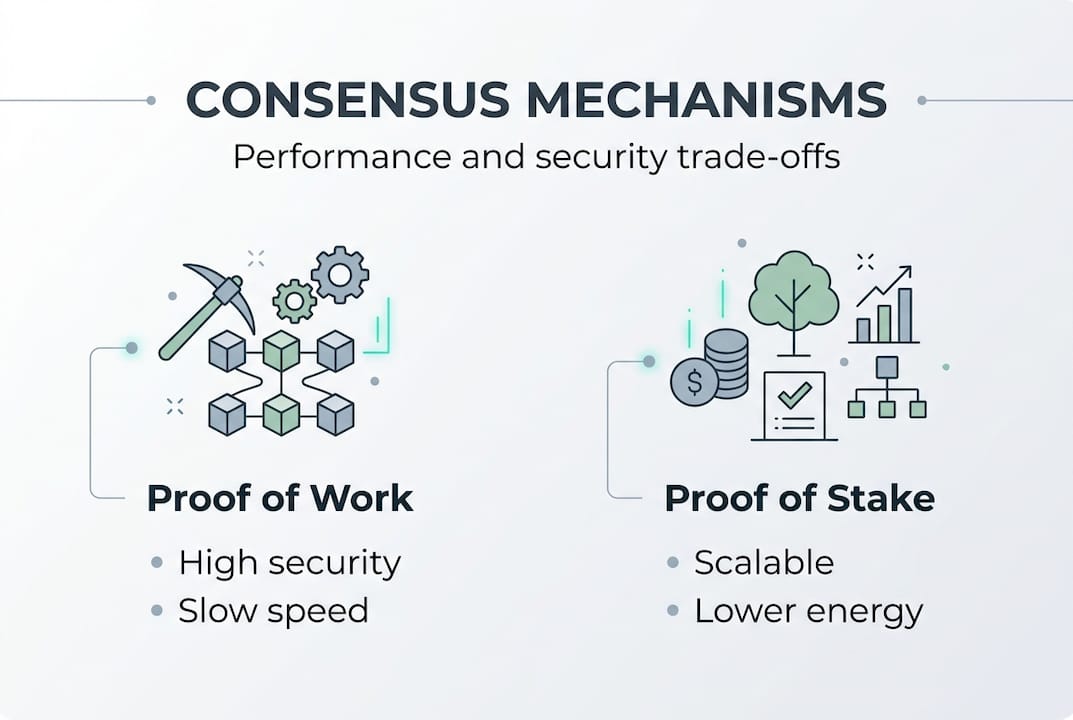
Performance benchmarks vary significantly: PoW offers high security but high energy use and lower transactions per second (TPS); PoS and voting-based mechanisms like PBFT provide better efficiency and immediate finality but involve trade-offs in decentralization.
Here is a comparison of the major consensus methods:
| Consensus method | Energy use | Security | Speed (TPS) | Decentralization |
|---|---|---|---|---|
| Proof of Work (PoW) | Very high | Very high | Low (7-30) | High |
| Proof of Stake (PoS) | Low | High | Medium (hundreds) | Medium-High |
| Delegated PoS (DPoS) | Very low | Medium | High (thousands) | Lower |
| PBFT | Very low | High | Very high | Lower |
A typical consensus process in a DLT network follows these steps:
- A user broadcasts a transaction to the network.
- Nodes receive the transaction and verify its validity against network rules.
- Validators or miners group valid transactions and propose a new block or record.
- The network runs its consensus protocol to agree on the proposed update.
- Once agreement is reached, the transaction is permanently recorded across all nodes.
- The updated ledger state is propagated to all participants.
For investors, the choice of consensus mechanism is a direct signal of a network’s priorities. A project using PoW signals a preference for maximum security at the cost of speed and energy. A project using PBFT or DPoS signals a preference for throughput, often at the cost of decentralization. Networks focused on on-chain privacy innovation often layer additional cryptographic techniques on top of their consensus layer. Understanding these trade-offs is as important as managing crypto risk in any portfolio strategy.
Current challenges and future risks for DLT
Even with robust mechanisms, DLT isn’t a cure-all. Investors must stay alert to significant technical and market risks that could affect the value and viability of DLT-based projects.
The most pressing challenges include:
- Scalability limits: Adding more nodes to a network can actually increase latency rather than improve performance, as consensus requires more communication between participants. This is a fundamental tension in decentralized system design.
- Settlement finality uncertainty: Not all DLTs provide the same guarantees. In PoW networks, finality is probabilistic, meaning a transaction is considered final only after enough blocks are added on top of it. PBFT-based systems offer deterministic finality, which is critical for institutional use.
- Interoperability risks: Settlement finality, interoperability risks at cross-network bridges, quantum computing threats, and scalability limits with more nodes increasing latency are all active concerns in capital markets. Cross-chain bridges have been among the most exploited attack surfaces in crypto, with hundreds of millions lost to bridge hacks in recent years.
- Quantum computing threats: Current cryptographic standards securing DLT networks, including elliptic curve cryptography, could eventually be broken by sufficiently powerful quantum computers. This is a long-term risk that serious investors and protocol developers are already tracking.
- Regulatory uncertainty: The evolving landscape of crypto regulation in 2026 adds another layer of risk for DLT-based projects, particularly those operating across multiple jurisdictions.
Key statistic: Cross-chain bridge exploits have accounted for a disproportionate share of total crypto losses, highlighting interoperability as one of the most urgent unsolved problems in the DLT space.
Investors evaluating DLT projects should also consult a solid blockchain scalability guide to understand how different networks are attempting to solve throughput limitations. The solutions being deployed today, including sharding, rollups, and layer-2 networks, each carry their own risk profiles and deserve careful scrutiny before capital is committed.
A practical perspective: what most DLT guides don’t tell you
Most explanations of DLT focus on the technology’s theoretical elegance and stop there. What they rarely address is the messy reality of real-world implementation, and that gap can be expensive for investors.
Enterprise DLT deployments, particularly permissioned networks like Hyperledger Fabric or R3 Corda, often outperform public blockchains for specific regulatory and compliance needs. These networks sacrifice open participation in exchange for speed, privacy, and governance control. For institutional investors, that trade-off can be entirely rational. For retail investors, it signals that not all DLT innovation will be accessible or beneficial to public token holders.
The more useful lens is alignment. Does the project’s DLT structure actually match its stated business goal? A supply chain application that needs privacy and high throughput probably shouldn’t be running on a public PoW blockchain. A decentralized lending protocol that needs censorship resistance probably shouldn’t rely on a permissioned network. Reviewing DLT transparency lessons from recent deployments reveals how often this alignment is missing in practice.
Pro Tip: Focus on how a project’s DLT structure aligns with its actual business aim, not just the buzzwords in its marketing materials. Misalignment between technology choice and use case is one of the clearest early warning signs of a project that will struggle to deliver.
Learn more and stay ahead in crypto and DLT news
As DLT continues to shape the crypto world, leveraging reliable, ongoing resources is the smartest move for investors and enthusiasts alike. The space moves fast, and staying informed is not optional if you want to make well-grounded decisions.

Crypto Daily covers the full spectrum of DLT developments, from protocol upgrades and regulatory shifts to emerging investment trends. Check the crypto outlook for 2026 for a macro view of where the market is heading. For a deeper technical foundation, the Bitcoin blockchain guide is an excellent companion to what you’ve read here. And for real-time updates on everything from DLT regulation to token launches, Crypto Daily keeps you ahead of the curve.
Frequently asked questions
What is the main advantage of digital ledger technology over traditional databases?
DLT decentralizes trust and reduces intermediaries, providing greater transparency and resilience compared to a single-point-of-failure database controlled by one entity.
Are all blockchains distributed ledger technologies?
Yes, every blockchain is a type of DLT, but not all DLTs use blockchain structures. Alternative architectures like DAGs also qualify as distributed ledger technologies.
How is transaction finality determined in different DLTs?
Finality depends on the consensus method: PoW is probabilistic while PBFT provides deterministic finality, meaning transactions are confirmed immediately and cannot be reversed.
Is DLT immune to all cyber risks?
No. DLT remains vulnerable to interoperability bugs and quantum threats, particularly at cross-chain bridges and through the long-term risk of quantum computing breaking current cryptographic standards.
Can DLT improve transaction speeds compared to traditional networks?
Yes. Certain DLTs using PoS and PBFT provide better efficiency and immediate finality, enabling transaction throughput that can significantly outpace legacy financial infrastructure.
Recommended
Disclaimer: This article is provided for informational purposes only. It is not offered or intended to be used as legal, tax, investment, financial, or other advice.