
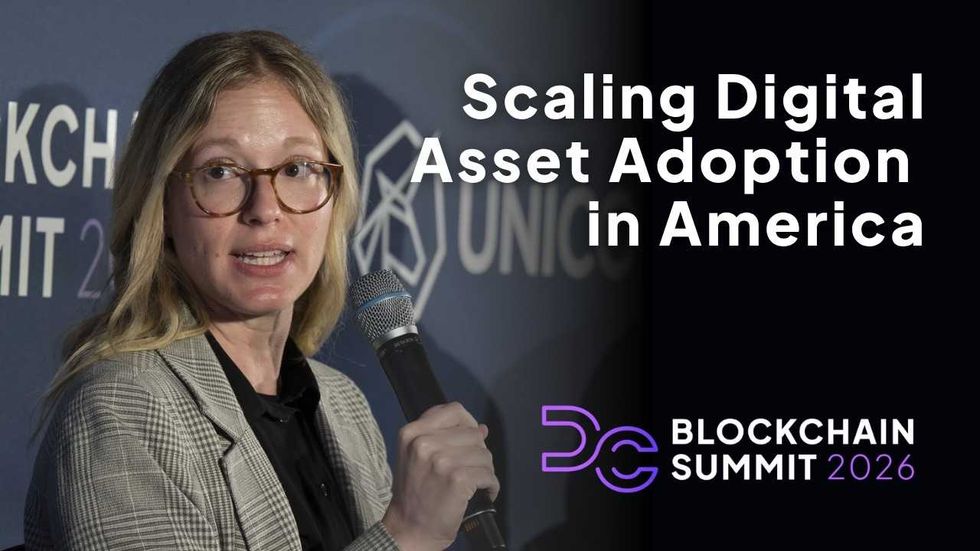
Presented at DC Blockchain Summit 2026 in Washington D.C.
The iOS codes are good for 1 year subscription at no cost, then will revert to standard price for Inheritance plan. iOS codes can be redeemed in the Apple App Store.
The Android codes are good for 90 days subscription at no cost, then will revert to standard price for Inheritance plan. Android codes are redeemed when selecting and paying for the Inheritance plan in the app.
Transcript
Wasim Ahmad:
Hello everyone. My name’s Wasim Ahmad. I’m co-founder of Vault12. We’re the pioneers in crypto inheritance, something that everyone will need once there is a wave of consumer crypto sweeping the country. We are going to whisk through introductions because the Congressman Timmons from South Carolina has a vote. So let me introduce the rest of the panelists. Ben Bois, co-founder and CEO of Coinflip. They have a network of 6,000 crypto ATMs in 10 different countries and Ali Tega from the National Cryptocurrency Association. So the first question, and it would be great to hear from you first, Congressman. We’re potentially months away from having a comprehensive digital asset regulatory framework in the US for the first time. And it would be great if you could paint a picture of what does the American consumer’s relationship with crypto look like 18 months from once that act passes.
Congressman William Timmons (R-SC):
Sure. First, thank you for having me. Good afternoon. I mean, number one is that we have to pass this. And I think the reason it’s being difficult, I thought it would’ve been done by now, is the degree of disruption. I think a lot of the people that are trying to protect market share, whether it’s the big banks, title insurance, you name it, just the people that are … It’s like Kodak before the iPhone. They’re looking at everything. They’re like, “This is going to be very disruptive.” And they’re trying to legislatively protect their market share. So it’s going to take a little pushing, but President Trump is very committed, very committed. And the industry has done a very good job of creating the incentives to pass clarity and obviously we’ve already passed Stablecoin. So I mean, it’s going to happen. The disruption is going to occur.
The question is how quickly and with whom first. Obviously, I think the big banks are going to deploy their new technologies, whatever they are. I’m excited to see them because instead of having to start from the bottom and grow, they’re going to spend hundreds of millions of dollars to create whatever new technologies, whatever new offerings they’re going to have. So I think that’s going to come out quickly. After that, there’s going to be probably a little bit of a lull as everyone becomes more used to these new technologies. And then I think it’s going to start pushing out the little guys and it’s going to be difficult to adapt. So I mean, I think Kodak is the best example and they’re gone for a reason. I don’t want a polar word camera. I got a cell phone. So I think that you’re going to see a lot of middlemen and different processes that are going to be gone and I think it’s going to be a good thing because efficiencies is the future.
Wasim Ahmad:
Go ahead.
Ali Tager :
Yeah. I love the Kodak example. I completely agree. I think the genie’s out of the bottle. The technology is already here and mainstream adoption is no longer a question of if but when. And I think it’s kind of twofold. From a consumer standpoint, I expect that we’re going to see more people sending money abroad or paying their friends back for brunch in crypto. It’s just going to give you another option, another choice. We’re going to see more people shopping with it at the register in stores and online, powering their businesses and passions and tokenizing real world assets. I think it’s going to be really meaningful and impactful ways that people are going to use this technology, but also really boring ways behind the scenes that we’re maybe already engaging with these tools and we don’t even realize it. But besides the consumer standpoint, I think the other piece that I expect to see, I hope to see, is more of a rise in accurate public discourse around this industry.
I mean, let’s be honest, there’s not a day that goes by that there’s not a hit piece in the New York Times about crypto painting us all as criminals and it’s all about illicit finance. But the reality is there are 55 million in counting Americans already using this technology and 76% of them say that the tool’s making a really positive impact on their lives. And that’s the story that I’m excited to see.
Ben Weiss:
I agree with both of you and I think we need to pass the market structure bill as soon as possible. I’ll say once the Genius Bill was passed, and I don’t know if it’s necessarily related or not, but we saw our Stablecoin purchases go up at the kiosk, not just in the US but in other countries. And I think that’s one of the interesting thing with Stablecoins is that it actually in a way dollarizes the world. And even from a business perspective operating in 10 countries, we use stablecoins to move money between our countries, not international wires. And then I also like your point too about there might be crypto and blockchain use behind the scenes that you don’t even notice. So for instance, when you swipe a credit card, there’s all sorts of things on the backend that happen like interchange fees and the average American when they swipe a credit card has no idea what an interchange fee is.
And I think when you talk about the settlement layer and infrastructure and finance behind the scenes, that could be the case as well, that crypto and blockchain could be used and the average consumer in certain cases might not even know, but their transaction’s more efficient and quicker because of it.
Congressman William Timmons (R-SC):
Let me throw one more piece in there. So China, Russia, India to a large extent, control capital flow. You can’t take your money out of the countries. And if you think about it, every time I walk through the airport, it’s like you have to declare more than $10,000. I just kind of chuckle. It’s kind of funny. I mean, digital wallets, non-custodial wallets self-custodial wallets are going to challenge authoritarian governments because they’re not going to be able to control their citizens wealth. And I think that that’s going to be something that we’re going to be dealing with for at least the next few decades.
Wasim Ahmad:
So Congressman, you are one of the few legislators who actually set up a self-custodial wallet and you’ve said publicly that when you did that, your own bank blocked you from moving funds on and off chain. So if a sitting member of Congress can’t get banks to cooperate with crypto, what hope do consumers have?
Congressman William Timmons (R-SC):
Well, I think they appropriately are waiting for market structure to pass. I think that there’s, well, previous to this administration, the last administration, there was absolute legal concerns. So I think that once we pass clarity, it’ll be easier, but I’m also very concerned. I mean, my mother is the best fraud target in the history of the world and she needs some guardrails and so it needs to be at least some sort of buyer beware situation. And so we got to work all that out, but I’m confident that that’ll get sorted out quickly.
Wasim Ahmad:
So Ben, you’ve noted that in 2025 a crypto company bought a TradFi company and a TradFi company bought a crypto company. You called it lines of blurring. When traditional financial institutions start offering crypto directly, does that threaten the coin flip kiosk ATM model or does it actually expand the market for everyone?
Ben Weiss:
I think it expands the market and anything that increases the use of crypto is just another opportunity for us to capture different markets of those segments or different segments of those markets, whether with their digital products, whether having ATMs in other countries where there’s less banking. But I think that’s a great point in the sense of like finance is finance. And if you look at the strategies of both, let’s say Robinhood, which started in TradFi, very consumer focused, but TradFi and then they went into crypto and then sort of Coinbase, even though they’re sort of crypto native first, they’ve got into sort of the traditional capital stack as well with prediction markets, derivatives. So I think you’re seeing whether it’s a TradFi company or a crypto company, I think a lot of companies are trying to be sort of the one stop shop for crypto and then stable coins or sorry, the one stop shop for finance in general, which that includes crypto.
And then Visa, they said that every bank needs to have a stablecoin strategy. So stablecoins are also one of the bridges between traditional finance and crypto.
Wasim Ahmad:
So Ali, you mentioned some statistics. 55 million Americans are already using crypto and I’d love to hear a little bit more about the demographics, but also using crypto and trusting crypto are two completely different things. So what does your data tell you about that gap, the trust gap and is regulation alone enough to close it or does the industry need to invest more in something like education?
Ali Tager :
Absolutely. Well, I’ll start at the end and say that regulation is a piece of it, but absolutely so is education. So before we talk about crypto holders, let’s talk about non-holders. We surveyed non-holders. We asked them, “Why aren’t you using crypto? What’s stopping you? ” We heard a little bit about regulation. We heard a little bit about, “I think I’ve missed the boat.” Definitely a little bit of, “I don’t trust it. I don’t get who’s backing it. I don’t know who controls it, ” which again, I think validates the need for education because it is decentralized and we all know how blockchain works, at least everyone in this room. But by and large, the number one barrier to entry is the knowledge gap. They do not get it. They don’t know what crypto is, how to set up a digital wallet, how to buy, sell, trade, hold.
And so we’ve actually just launched a bunch of hands-on learning resources on our website to teach people the basics without the hype or without the jargon, really simple, accessible, snackable explainers and a risk-free simulator so you can actually practice it. So for all the crypto skeptics in your lives, send them to our site. But for crypto holders, it’s not the bros that we’ve all been told it is. A third of crypto holders are women, more are over 55 than under 25, more work in construction than in finance and they span races, regions, religions, and political party lines. It’s actually pretty evenly split. And so I think that when it comes to crypto holders, we found that they trust the technology on average equal to or greater than their trust in traditional banking institutions. And when it comes to crypto holders of color, that doubles. They trust crypto more than twice as much as they trust traditional banking.
So it really does level the playing field.That’s
Wasim Ahmad:
Really fascinating. Where can people get access to these statistics?
Ali Tager :
I swear I didn’t even pay him to ask me that. NCA.org on our website. We’ve got lots of great research reports as well as stories from real people all across the country who are, like I said earlier, using this technology in really powerful ways, like gaining financial sovereignty and freedom from an abusive relationship to really maybe boring ways like tracking livestock on the blockchain so you can find out how big your cows are going to be.
Wasim Ahmad:
Great. Okay. Congressman, another question about banks. So once the market structure bill passes and assets have a clear path to register either as commodities or securities, I’m hoping we’ll have an announcement on that this afternoon. What’s your expectation about how quickly traditional banks are going to actually move to offer crypto products? Is it months or years or what do you
Congressman William Timmons (R-SC):
Think? I think it’ll be very quick for the big banks. I think that they have been anticipating this for a long time and they’ve invested enormous amounts of money and they’re keeping their cards close because they want to wow everybody with whatever new toys they have. Now I think once you get smaller, it’s just hard for them to compete. They can’t invest the resources necessary to even understand why this is important. I talk to a lot of smaller banks and credit unions and I ask them, “Is this top of mind for them?” And they do not say yes. And I’m just like, “You need to go read the Kodak case study.” It’s as simple as that. So I think that it’s going to take time for it to be truly disruptive because I think that in rural banks and in smaller credit unions and whatnot, their customers are probably going to be a little slower to adopt, but it’s going to be a generational thing eventually because the cost savings, the efficiencies, it’s going to change the world.
And so they’re not going to be able to avoid the hit for long, but I promise you the big banks are going to adapt and they’re going to compete and I think everybody’s going to be better off because of it.
Wasim Ahmad:
Well, I want them to do that very, very quickly, but I’m a little skeptical because I’ve been asking a lot of, every time I live in New York, so I bump into bankers all the time and I’m not hearing that the banks have had huge hiring sprees of getting people from the crypto industry to come in. We already talked about education for consumers, but who is going to educate the people that are on the other end of the phone line or the chat prompt? So I’m a little more skeptical, but yes, there is definite sort of green shoots in that area. I think recently Wells Fargo made some announcements. JP Morgan, even though all the banks are creating a ruckus right now with the Clarity Act, there is movement for sure, but I just wonder if they have recruited early enough and in the biggest possible way.
I don’t know if you have a view on that, Ben.
Ben Weiss:
I agree with you on this type of bank. We see a lot of community banks, someone who went through the whole debanking and operation choke point, thankfully the US has community banks. Some countries just have four banks and we’ve seen them sort of be more scared or just not even thinking of crypto. I think sometimes with the bigger banks you hear blockchain, not Bitcoin and there’s still a skepticism, but I think again, it’s sort of a case by case basis and the great CEOs and the great companies are always looking, how do we in a way cannibalize our existing product because the future moves on. Like Kodak, if they were going to succeed, would have had to cannibalize their polarized cameras. So I think the smartest banks sort of see where this is going, not that they don’t care about traditional deposits and mortgages and all that, but they’re trying to at least incorporate the technology and spend money on R&D.
Wasim Ahmad:
So Ben, your company has a network of more than 6,000 ATMs, crypto ATMs in 10 different countries. So the idea of going to an ATM putting in a card or a fingerprint or something and then withdrawing some type of currency, is that taking kind of consumers in the direction of crypto transactions to buy pizza or buy coffee, or is that taking them down the path of this is a great store of value? Can you talk a little bit about that concept?
Ben Weiss:
It depends. I would say in the US primarily a store of value like Bitcoin is the hardest, most inflation proof asset there is. But for instance, we operate in South Africa and the brand depreciates a lot and we see a bunch of people buying stablecoins and using that as a store of value. Sort of maybe they have extra savings that they keep in Bitcoin, but sort of their checking account in a way is in stablecoins. And even in terms of like one of the things that I think gets crypto more adoption is just easier to use, easier interface. Like for instance, in South Africa, we have the ATMs and the malls and like in the US you call customer support. In South Africa, we actually not only have a phone line, but we have someone standing in a coin flip t-shirt in front of the ATM to teach people how to use it.
And obviously we can do that in countries like South Africa because of the cost structure, but I think it’s both, it can be a store of value, but I think in countries with destabilized currencies where there’s not a lot of payment mechanisms, they might not trust the banks, you see it as a day-to-day exchange of value.
Wasim Ahmad:
Okay. Congressman, before you step off the panel to go vote, can you tell us what you think one thing policy, product, cultural shift that would do more to scale adoption than anything else that we’ve kind of talked about today?
Congressman William Timmons (R-SC):
I mean, I think education’s everything and people don’t understand the different use cases and how the efficiencies will be created. It’s hard to even fully grasp some of the changes that are going to occur. I mean, my family has a privately held company and we spend tens of millions of dollars on corporate compliance and on maintaining stock records and all of that. I mean, that’s going to be on the blockchain in five, 10, 15 years and just all of the different businesses that are going to be gone because technology can automate it and do it way better, way faster. So I just think education’s going to be everything. And I think once we pass market structure, once all of the investment that has been sitting on the sidelines is unleashed, I think you’re going to see education and people understanding all the different use cases and how it’s going to change their lives.
I mean, I think it’s fantastic and I hope that we can get this right and get it done quickly because I mean, this should have been done months ago and again, the reason this is not done yet is because the people that are anticipating market disruption are trying to legislatively control market share and that’s bad. And so we’ve got to make sure that we push past that and we get the legislative framework right and off to the races.
Wasim Ahmad:
Thank you very much, Congressman. Okay. We’re going to carry on. We have a little more time to discuss some things. So Ali, obviously we’re at this pivotal moment for regulatory clarity, but I want to sort of delve into this idea that as far as the average American consumer is concerned, we’ve had this narrative coming from the media, from politicians, not all politicians, but some politicians, that crypto is for billionaires, that crypto is for scams and terrorists, whole narrative about, “Oh, it’s volatile, you can’t trust it. ” So how are we going to convince the average crypto consumer that it’s safe and accessible?
Ali Tager :
Yeah, absolutely. I think for starters, the NCA is a nonprofit that’s here to help everyday people understand what crypto is and how to use it safely and responsibly. So I like to think our role is less about convincing and more about educating, but we’re doing that by busting the myths and misconceptions and hype and jargon with data and facts and stats and real stories of real people. So much of the narrative around crypto, as we all know, is about the hype, the possibility, the potential, the future. We’re talking about the present. We’re talking about real people in your neighborhoods, lots of people in this room, I’m sure, our friends, our families who are using this as a way to have more accessibility, have twenty four seven access, have more ownership and control over their assets. But at the same time, we can’t pretend that scams and volatility aren’t a problem.
However, they are a problem in every corner of the internet and every industry. And so I think that how we can show up and help people is by teaching them how to spot scams with warning signs of fraud, what to do if and when you think you or your loved one might be dealing with a scammer or a fraudster. Because again, what we’re seeing with crypto is the same as what we see with traditional banking. It’s the same as we see even on online dating, cat phishing, impersonation scams, especially with the rise of AI. But what we’re seeing right now with crypto is the same journey that we’ve seen play out time and time again with any new tool or technology and innovation AI, cell phones, right? Going back to even electricity and cars and railroads, when something comes along that’s going to break barriers and disrupt traditional systems, some people are incentivized to want to stop that.
And so there’s a lot of fear mongering that’s happening and what we’re really trying to do is show that this is a tool that’s helping normal people like us in a lot of normal ways. I think to pile on to what you were saying earlier, investing, of course, the long-term store of value is a huge use case for digital assets, but I’ve been really surprised by some of the data that we’ve seen, including reports we just did with PayPal around the holidays where about a fifth of US shoppers were gifting crypto. About a quarter said they would prefer crypto over a gift card in their Christmas stocking or wherever you get your gifts. And so I think people are starting to see this as a way to spend and to donate to nonprofits like Movember and also too, like we talked about beyond crypto blockchain.
You can tokenize pretty much anything these days and use it for reducing fraud and making sure that you have trackable, traceable, immutable ledgers. And I think that’s really where I see the possibility and the potential of the technology.
Wasim Ahmad:
So we have really kind of focused on the sunshine above the cloud side of the moment that we’re in. And Ben, I wonder if you could comment on … Your company’s been around for 10 years, so you’ve seen your fair share of go slow market momentum and then lack of market momentum.What happens in November if the sides change and there’s no Clarity Act enacted?
Ben Weiss:
Well, I’m hoping, I think someone said it on the last panel that we’ve gotten sort of crossed the Rubricon or move the Overton window where the Operation Choke Point or the law fare against crypto would hopefully not come back. But I think dealing with a patchwork of state laws, dealing with sort of that regulatory uncertainty does slow down the market and wouldn’t be good. That being said, there are a lot of Democrats I think who are, they got a lot of votes on the Genius Bill. So hopefully even in the next … We want to get this passed now, but even in the next Congress, hopefully there’s sort of enough momentum to get something done. And you were talking about PayPal. I was watching a clip on X at like two in the morning where Peter Thiel was like, because they had a huge fraud issue when they first started and I was watching the clip and he’s like, “We have to get the network large enough before the politics catches up to it.
” So I think we have to get the, and hopefully we’re there, but we have to get crypto in enough people’s hands. We have to get enough consumers, politicians, regulators educated on it and just realizing it’s a neutral to beneficial technology just because bad people misuse it just like in normal finance doesn’t discredit the technology.
Ali Tager :
Yeah. To build on that, some of the conversation we were having backstage was about people just outright dismissing crypto of, “It’s not for me. ” And again, where does that come from? The conversation I like to have with the skeptics that I meet in the wild is, “Oh, I don’t get it. I don’t know what’s in it. I don’t know who’s backing it and it’s not for me. ” And I’m like, “Okay, can I be nosy for a second? Do you have a 401k?” And of course the answer is always yes. And then my follow-up question is, what’s in it? Nobody ever knows and we trust it because we grew up with it and it’s a familiar tool. And so I think that with businesses like PayPal getting on board with traditional banks and other institutions getting on board, it will start to feel familiar and normal and just inherently safer.
But at the same time, it’s our responsibility at the NCA to help people understand how to navigate this safely and responsibly. And it’s
Ben Weiss:
About meeting the customer where they’re at. I think that’s the key to adoption. Some people are not going to buy crypto unless it’s through an ETF or their 401k. Some people are going to keep it on a treasure or a paper wallet. Some people might buy it at ATM. Some people are going to buy it at PayPal or Robinhood. So I think it’s about meeting the customer where they are and then all those other sort of ancillary financial services like inheritance. It’s amazing to have $10 million of crypto on a treasure. It’s not so amazing if you’re sick and you have kids and you haven’t thought about like the estate planning or how to transfer to them. So I think whether it’s donations, tax and estate, all those sort of things you see in traditional finance, we have to bring those over to crypto as well.
Wasim Ahmad:
Well, thank you for ending on that. I appreciate it. Go talk to a lawyer. That’s all we have time for. Thank you so much.