

Ethereum is struggling to regain the $3,000 level as the broader cryptocurrency market remains stuck in a phase of uncertainty and uneven certainty. Price action suggests buyers are willing to defend key support zones, but momentum remains weak as the pair struggles to sustain meaningful gains. This hesitation comes against a backdrop of increased leverage and volatile derivatives behavior, which continues to shape near-term market dynamics.
Related Reading
A recent report from CryptoQuant highlights the growing sources of risk beneath the surface. Ethereum’s expected leverage ratio on Binance remains at an all-time high and its 7-day simple moving average remains around 0.632.
This indicates a concentration of leveraged positions, making the market increasingly sensitive to sudden price movements and liquidation events. At the same time, order flow data points to erratic trader behavior, reinforcing the view that the current structure lacks balance.
The taker buy sell ratio clearly shows this instability. On January 25, it fell to 0.86, the lowest since September, signaling a strong taker selling advantage. Soon after, it rebounded sharply to 1.16, its highest daily high since February 2021, reflecting aggressive market buying. This sudden reversal highlights the market. Driven more by short-term positioning than by ongoing directional trust.
The report explains that the sudden change in taker behavior is unfolding while Ethereum price action remains structurally weak. After failing to break the all-time high of $4,800, ETH has entered a prolonged correction phase and is currently consolidating near the $2,800 support zone.
This level becomes a short-term pivot, repeatedly absorbing selling pressure but failing to generate sustained upward momentum. The lack of follow-through highlights a market stuck between defensive buyers and aggressive short-term traders.
What makes this stage particularly sensitive is the interplay between price compression and increased leverage. With Ethereum’s expected leverage ratio still near all-time highs, even small price movements could trigger a big reaction in the derivatives markets.

Sharp reversals in taker buy-sell ratios reinforce this vulnerability, indicating that positioning is shifting rapidly rather than being established in a stable directional manner. These situations are often preceded by a sharp increase in volatility rather than an orderly trend.
In this setup, Ethereum appears to be heavily dependent on a clear external or internal catalyst. Absent decisive changes in macro conditions, spot demand or network-specific developments, price action is likely to remain reactive. Until both parties are found guilty, the combination of high leverage and unstable order flow increases the risk of sudden liquidations and increases the likelihood of sudden and disorderly price movements at key technical levels.
Related Reading
Price Action Details: Critical Resistance Test
Ethereum’s price action reflects a market between stabilization and unresolved downside risk. On the daily chart, ETH is trading near $3,000 after several failed attempts to reclaim higher levels, highlighting this area as a key psychological and technical pivot.
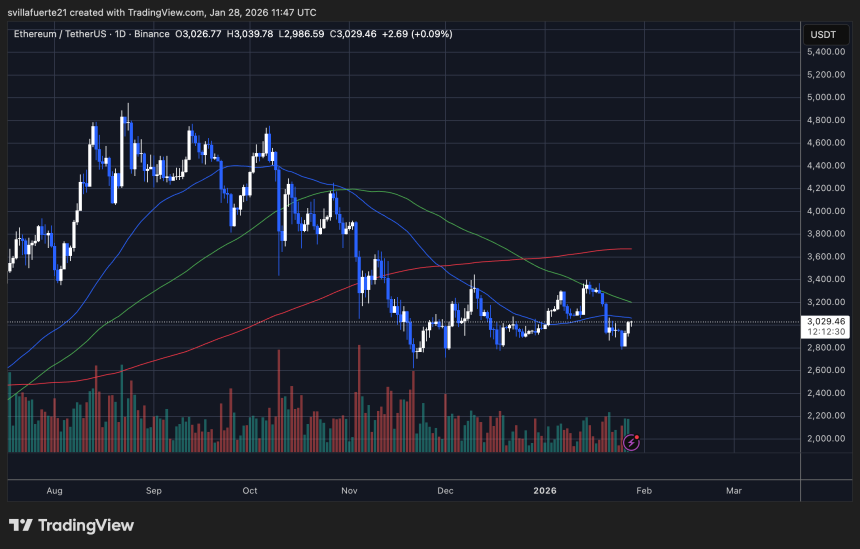
Prices remain below the 50-day and 100-day moving averages, both of which are trending downwards, reinforcing the idea that short- and medium-term momentum remains weak. The 200-day moving average is sitting higher near the mid-$3,500 level, which serves as a clear indicator of a broader trend deterioration after ETH failed to sustain above $4,000.
Related Reading
ETH has transitioned from a strong impulsive uptrend into a wide consolidation range roughly between $2,800 and $3,400. The recent bounce from the lower end of this range suggests that buyers are still defending the $2,800 support zone, but volume is still low compared to previous selling, indicating a lack of strong conviction on both sides. Each rally attempt so far has produced lower highs, consistent with a correction or distribution phase rather than a new trend.
As long as ETH stays above $2,800, the market can argue for consolidation and building ground. However, a continued decline below this level could expose the bears to the $2,500-$2,600 region. Conversely, a meaningful improvement in the technical outlook would require a resurgence in the $3,300-$3,400 region.
Featured image from ChatGPT, chart from TradingView.com