

Crypto Flexs
  • DIRECTORY
  • CRYPTO
    • ETHEREUM
    • BITCOIN
    • ALTCOIN
  • BLOCKCHAIN
  • EXCHANGE
  • TRADING
  • SUBMIT
Crypto Flexs
  • DIRECTORY
  • CRYPTO
    • ETHEREUM
    • BITCOIN
    • ALTCOIN
  • BLOCKCHAIN
  • EXCHANGE
  • TRADING
  • SUBMIT
Crypto Flexs
Home»ETHEREUM NEWS»Ethereum staking provider dumps Geth for Besu as client decentralization race heats up.
ETHEREUM NEWS

Ethereum staking provider dumps Geth for Besu as client decentralization race heats up.

By Crypto FlexsJanuary 27, 20243 Mins Read
Facebook Twitter Pinterest LinkedIn Tumblr Email
Ethereum staking provider dumps Geth for Besu as client decentralization race heats up.
Share
Facebook Twitter LinkedIn Pinterest Email

In a move toward a more diverse Ethereum-running client ecosystem, staking provider AllNodes presentation A complete transition from Geth to Besu. With this change, AllNodes eliminated the use of Geth from its entire network of 23,895 nodes, marking a milestone in its ongoing efforts to reduce the current centralization around Geth, its majority client.

AllNodes are migrated to Besu.

The non-custodial staking provider said in a post to Geth is the most widely used running client for Ethereum nodes, but analysts are concerned about its dominance and potential security vulnerabilities if Geth is exposed to bugs.

Ethereum price is showing a downward trend on the daily chart | Source: ETHUSDT on Binance, TradingView

The transition to Besu is consistent with AllNodes’ commitment to providing the most secure and stable staking infrastructure to its customers. Developed by ConsenSys, Besu is a high-performance, secure execution client that offers several advantages over Geth.

This development significantly improves decentralization efforts for Rocket Pool, an Ethereum staking protocol that utilizes mini-pools. Rocket Pool’s minipool operators are free to utilize AllNodes’ staking and node hosting services. Even though some of Rocket Pool’s minipool operators still use Geth, AllNodes’ decision to switch to Besu further strengthens Ethereum’s resilience to potential client-side errors.
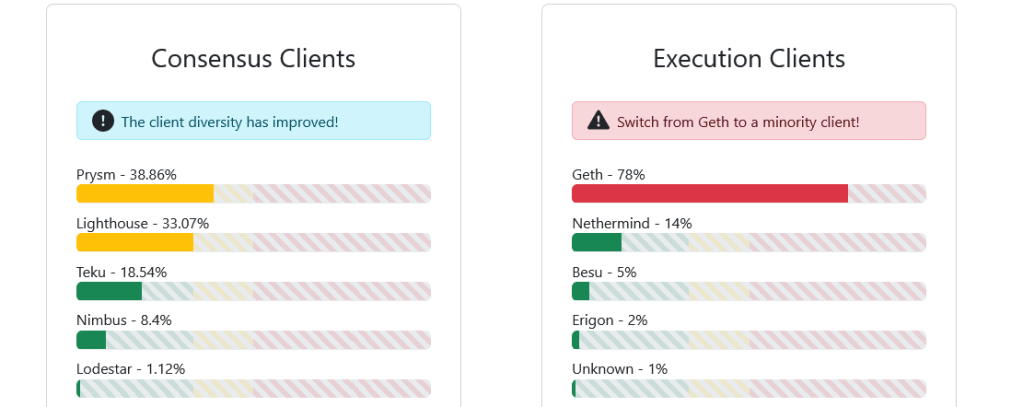
Geth is the preferred Ethereum running client |  Source: Client Diversity
Geth is the preferred Ethereum running client | Source: Client Diversity

The current Ethereum validator landscape still heavily favors Geth. Data on Client Diversity show More than 75% of all validators rely on this client. However, given the current awareness that client errors can negatively impact network stability, it is likely that more staking providers will diversify their base with others following AllNode. As more validators are distributed across Nethermind, Geth, Besu, and other clients, Ethereum will become more resistant to potential forks and security issues.

There is no recourse for Ethereum node operators if Geth fails.

Marius, an analyst for explained Anyone can use any client, and they are even drawn to Geth, the first and most popular Ethereum running client. But the analyst claims there will be no “bailout” if the network diverges.

Buggy Geth inevitably exposes validators to the risk of catastrophic loss, causing a network fork as it already controls more than 66% of the nodes needed for finality. Validators running those clients can receive a penalty of up to 32 ETH, effectively eliminating their stake.

The Ethereum network typically “cuts” a validator node’s stake when its reliability falls below 100%. The longer you are offline, the higher the slashing penalty.

Featured image from Canva, chart from TradingView

Share. Facebook Twitter Pinterest LinkedIn Tumblr Email

Related Posts

Is Ethereum transitioning into the AI ​​industry? Here’s what we know so far:

February 3, 2026

Ethereum leverage remains at an all-time high. What happens next?

January 30, 2026

BlackRock supports Ethereum gatekeeping tokenization despite market share being threatened.

January 26, 2026
Add A Comment

Comments are closed.

Recent Posts

‘Real users vote with money’ – Binance maintains global lead despite FUD

February 5, 2026

Tether freezes $182 million in USDT, emphasizing centralized control of stablecoins.

February 4, 2026

Tramplin Introduces Premium Staking On Solana, A Proven Savings Model Rebuilt For Crypto

February 4, 2026

Zeta Network Group Outlines Strategic Focus On Real-World Asset Tokenisation As Part Of Institutional Digital Treasury Strategy

February 4, 2026

LBank launches 15th BoostHub campaign featuring Bitcoin offering 1 BTC as reward

February 4, 2026

Cango Inc. Announces January 2026 Bitcoin Production And Mining Operations Update

February 4, 2026

Hyperliquid enters prediction market, HYPE increases by 20%

February 3, 2026

Blockchain.com & Ondo Finance Launch Onchain Tokenized U.S. Stocks Across Europe

February 3, 2026

XMoney Appoints Raoul Pal As Strategic Advisor To Support The Next Phase Of Global Payments

February 3, 2026

Superform Expands To The U.S. With Mobile App Launch For A User-Owned Neobank

February 3, 2026

Enjin Launches Essence Of The Elements: A Cross-Game Multiverse Journey

February 3, 2026

Crypto Flexs is a Professional Cryptocurrency News Platform. Here we will provide you only interesting content, which you will like very much. We’re dedicated to providing you the best of Cryptocurrency. We hope you enjoy our Cryptocurrency News as much as we enjoy offering them to you.

Contact Us : Partner(@)Cryptoflexs.com

Top Insights

‘Real users vote with money’ – Binance maintains global lead despite FUD

February 5, 2026

Tether freezes $182 million in USDT, emphasizing centralized control of stablecoins.

February 4, 2026

Tramplin Introduces Premium Staking On Solana, A Proven Savings Model Rebuilt For Crypto

February 4, 2026
Most Popular

U.S. crypto taxes in 2024: fast facts

February 15, 2024

BTFS Protocol V3.3.0 Testnet is a new feature.

March 19, 2025

Gate.io Announces $SOULS Token Migration Support

March 9, 2024
  • Home
  • About Us
  • Contact Us
  • Disclaimer
  • Privacy Policy
  • Terms and Conditions
© 2026 Crypto Flexs

Type above and press Enter to search. Press Esc to cancel.