

The first week of the year has not been unkind to the markets, as Ethereum (ETH) enters 2026 with a mixed narrative reflecting both progress and restraint. On the one hand, the network is overcoming long-standing technical limitations and the scope of practical use is becoming wider.
On the other hand, market data showed that price movements were suppressed due to continued selling pressure. These trends suggest that Ethereum is experiencing fewer declines than transitions, balancing structural growth with a cautious market environment.
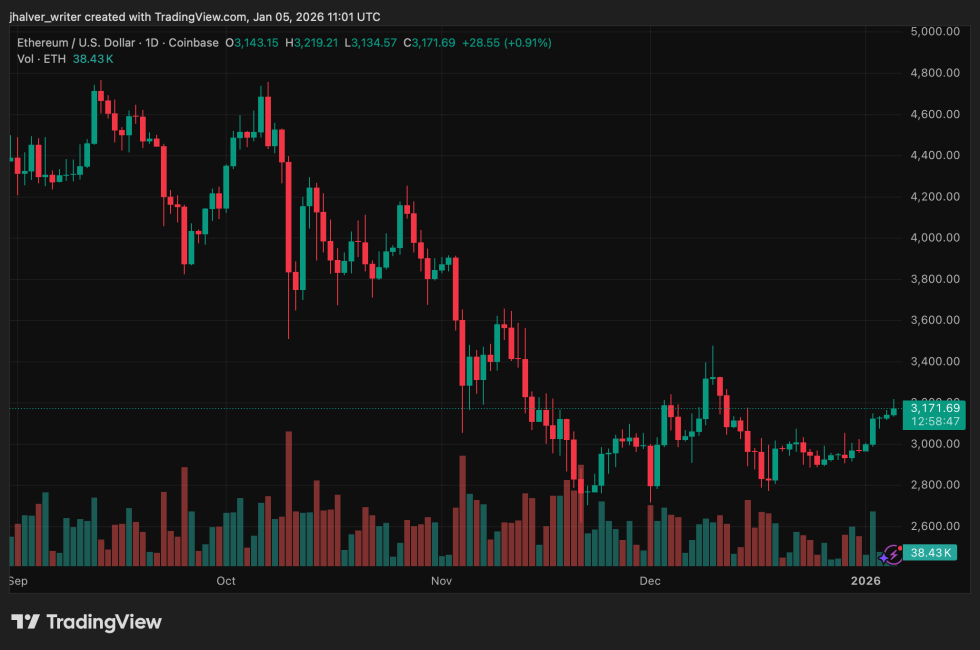
ETH's price trends slightly to the upside on the daily chart. Source: ETHUSD on Tradingview
Technology advancements and network upgrades
Recent remarks by Ethereum co-founder Vitalik Buterin have sparked renewed interest in the progress of the blockchain trilemma, the challenge of balancing decentralization, security, and scalability.
According to Buterin, upgrades such as PeerDAS (Peer Data Availability Sampling) and zkEVM (Zero-Knowledge Ethereum Virtual Machines) have moved this goal from theory to real-world conditions on the mainnet.
PeerDAS, introduced with the Fusaka upgrade last December, reduces the burden on verifiers by allowing them to check data availability through sampling rather than processing the entire data set. This improves scalability while maintaining accessibility to participation.
At the same time, zkEVM has reached an early operational stage, which drastically reduces proof generation time and significantly reduces verification costs. Although still in alpha stage, these systems are expected to take on a larger verification role between 2027 and 2030 as additional security enhancements are implemented.
Along with performance improvements, Ethereum’s roadmap is moving towards protocol safety. The Ethereum Foundation has set a goal of achieving 128-bit provable security by the end of 2026, indicating that recent speed and cost improvements are aligned with increasingly stringent security goals.
Ethereum (ETH) adoption is shifting towards utilities.
Beyond its core protocol operations, Ethereum’s usage indicators point to growing adoption. In the fourth quarter of 2025, stablecoin transfers on the network exceeded $8 trillion, nearly double the amount from the beginning of the year.
Active addresses and daily transactions also reached record levels, reinforcing Ethereum’s role as the primary clearing layer for payments and tokenized assets.
The industry is increasingly pointing to cryptocurrency neobanks as a key growth driver in 2026. These platforms combine self-custodial, stablecoin, and yield products with a familiar banking interface, lowering the barrier to mainstream users.
2025 Institutional participation, particularly through structures around digital asset treasury and staking, has helped lay the foundation for a shift toward everyday financial use rather than short-term transactions.
Market pressure and developer momentum
Despite these developments, market flow data indicates that Ethereum is still under prevailing selling pressure, reflecting a broader de-risking trend across crypto assets. This has limited upside and led to more price volatility despite the positive narrative emerging.
Likewise, developer activity tells a different story. Approximately 8.7 million smart contracts were deployed in the fourth quarter of 2025, the highest quarterly figure ever recorded.
Taken together, Ethereum’s current signals point to consolidation rather than contraction. While market conditions continue to weigh on pricing, technological advances and increased adoption indicate that the network is positioning itself for the next phase of growth once broader pressures ease.
Cover image by ChatGPT, ETHUSD chart by Tradingview

editing process for bitcoinist focuses on providing thoroughly researched, accurate, and unbiased content. We adhere to strict sourcing standards and each page undergoes diligent review by our team of top technology experts and seasoned editors. This process ensures the integrity, relevance, and value of the content for readers.