

Crypto Flexs
  • DIRECTORY
  • CRYPTO
    • ETHEREUM
    • BITCOIN
    • ALTCOIN
  • BLOCKCHAIN
  • EXCHANGE
  • TRADING
  • SUBMIT
Crypto Flexs
  • DIRECTORY
  • CRYPTO
    • ETHEREUM
    • BITCOIN
    • ALTCOIN
  • BLOCKCHAIN
  • EXCHANGE
  • TRADING
  • SUBMIT
Crypto Flexs
Home»ADOPTION NEWS»NVIDIA’s VISTA-2D model revolutionizes cellular imaging and spatial omics
ADOPTION NEWS

NVIDIA’s VISTA-2D model revolutionizes cellular imaging and spatial omics

By Crypto FlexsJuly 25, 20243 Mins Read
Facebook Twitter Pinterest LinkedIn Tumblr Email
NVIDIA’s VISTA-2D model revolutionizes cellular imaging and spatial omics
Share
Facebook Twitter LinkedIn Pinterest Email

Jorg Hiller
25 Jul 2024 02:15

NVIDIA presents VISTA-2D, a model that improves cell segmentation and shape clustering in spatial omics, providing a major advance in biology research.


According to the NVIDIA Technical Blog, NVIDIA has unveiled VISTA-2D, a baseline model designed to significantly improve cell segmentation in cellular imaging and spatial omics workflows. The model aims to improve the accuracy of downstream tasks by leveraging advanced image embedding techniques.

Feature Extraction and Clustering

The VISTA-2D model uses an image encoder to generate embeddings that can be converted into segmentation masks. These embeddings provide essential information about cell morphology, enabling accurate cell segmentation. NVIDIA’s blog post explains that these embeddings can be clustered to automatically group cells with similar morphology.

To demonstrate the capabilities of the model, NVIDIA has provided a detailed Jupyter notebook that walks users through the process of segmenting cells and extracting spatial features using VISTA-2D. The notebook also shows how to cluster these features using RAPIDS, creating an automated pipeline for classifying cell types.

Prerequisites and setup

Users interested in exploring the VISTA-2D model will need a basic understanding of Python, Jupyter, and Docker. The Docker container required for this tutorial can be started with the following command:

docker run --rm -it \
    -v /path/to/this/repo/:/workspace \
    -p 8888:8888 \
    --gpus all \
    nvcr.io/nvidia/pytorch:24.03-py3 \
    /bin/bash

Additional Python packages required for the tutorial can be installed using:

pip install -r requirements.txt

Cell segmentation using VISTA-2D

The initial step is to load the VISTA-2D model checkpoint and use it to segment cells in the image. The segmentation process generates a feature vector for each cell, which contains all the information needed to analyze cell morphology. These vectors are then used in a clustering algorithm to group cells with similar features.

cell division

The segmentation function processes cell images via VISTA-2D to generate a segmentation mask that individually labels each cell, allowing for accurate feature extraction for each cell.

img_path="example_livecell_image.tif"
patch, segmentation, pred_mask = segment_cells(img_path, model_ckpt)

Split plotting

The segmented image can be visually verified using the plot_segmentation function, which displays the original image, the segmentation results, and individual masks for each cell.

plot_segmentation(patch, segmentation, pred_mask)
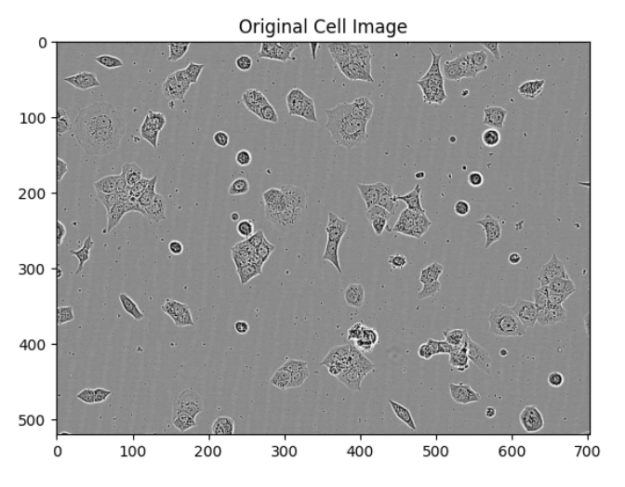
original-cell-image-625x487.png
a) Original cell image
segmentation-625x480.png
b) Segmentation
Individual Mask 625x485.png
c) Individual masks
Figure 2. VISTA-2D segmentation results

Clustering features using RAPIDS

Once the feature vectors are extracted, they are clustered using RAPIDS, a GPU-accelerated machine learning library. The TruncatedSVD algorithm reduces the dimensionality of the feature vectors, making it easier to visualize clusters in 3D space.

dim_red_model = TruncatedSVD(n_components=3)
X = dim_red_model.fit_transform(cell_features)

We then cluster the reduced feature vectors using the DBSCAN algorithm. This method assigns a cluster label to each cell, which can be visualized using Plotly for interactive 3D plots.

model = DBSCAN(eps=0.003, min_samples=2)
labels = model.fit_predict(X)
interactive-3d-diagram.png
Figure 3. Interactive 3D diagram generated from the plot of clustered feature vectors.

conclusion

NVIDIA’s VISTA-2D model provides accurate cell segmentation and feature extraction, providing significant advances in cell imaging and spatial omics. Combined with RAPIDS for clustering, this model efficiently classifies cell types, paving the way for more detailed and automated biological studies.

Image source: Shutterstock


Share. Facebook Twitter Pinterest LinkedIn Tumblr Email

Related Posts

AAVE Price Prediction: $100 is the wall. Factors that can destroy or bury a wall include:

July 25, 2026

Multicoin Capital has made its first Hyperliquid ecosystem investment in Trasia, an Asia-focused trading platform.

July 17, 2026

Polymarket Probability Price The probability that the United States will invade Iran before 2027 is 16.5%.

July 9, 2026
Add A Comment

Comments are closed.

Recent Posts

CT3 Begins Preparing Its Ecosystem for the Launch of the CT3GB Economy

August 10, 2026

Syntetika Launches Tokenization Hub Bringing Regulated Investment Strategies Onchain

August 10, 2026

Bitmine Immersion Technologies (BMNR) Announces ETH Holdings Reach 5.81 Million Tokens, and Total Crypto and Total Cash Holdings of $11.6 Billion

August 10, 2026

MEXC Sponsors Yohani’s Colombo Concert, Bridging Sri Lankan Culture and Global Digital Finance

August 10, 2026

Beyond the Headline Bonus -How to Measure Real Value at a Crypto Casino

August 8, 2026

Bybit Sues North Korea and Lazarus Group, Secures Preliminary Injunction Freezing Stolen Assets in Landmark Crypto Asset Recovery Effort

August 8, 2026

Carbon Launches TradFi-Native On-Chain Derivatives Venue With 950+ Markets in One Account

August 7, 2026

MEXC Lists New Ondo Tokenized Stock Pairs Spanning AI Infrastructure, Semiconductor and Rare Earth Sectors

August 7, 2026

ORBS) Reports Total Holdings of Approximately $378 Million, Includes OpenAI, Beast Industries, More Than 16,000 ETH and Nearly 302 Million WLD Tokens

August 6, 2026

ChangeNOW Brings Martin Masser Into Its Crypto Super App

August 5, 2026

MEXC 0808 debuts as an annual brand event with Stock Season and a $500,000 prize pool

August 5, 2026

Crypto Flexs is a Professional Cryptocurrency News Platform. Here we will provide you only interesting content, which you will like very much. We’re dedicated to providing you the best of Cryptocurrency. We hope you enjoy our Cryptocurrency News as much as we enjoy offering them to you.

Contact Us : Partner(@)Cryptoflexs.com

Top Insights

CT3 Begins Preparing Its Ecosystem for the Launch of the CT3GB Economy

August 10, 2026

Syntetika Launches Tokenization Hub Bringing Regulated Investment Strategies Onchain

August 10, 2026

Bitmine Immersion Technologies (BMNR) Announces ETH Holdings Reach 5.81 Million Tokens, and Total Crypto and Total Cash Holdings of $11.6 Billion

August 10, 2026
Most Popular

5 Best Cryptocurrencies to Buy Now – BTC, SEI, LPX, SUI, BONK

January 25, 2024

Automated OTC trading is now available on Kraken Custody.

January 4, 2025

Top 5 Cryptocurrency Alternatives to Surpass the Rise of Bonk

December 16, 2023
  • Home
  • About Us
  • Contact Us
  • Disclaimer
  • Privacy Policy
  • Terms and Conditions
© 2026 Crypto Flexs

Type above and press Enter to search. Press Esc to cancel.