
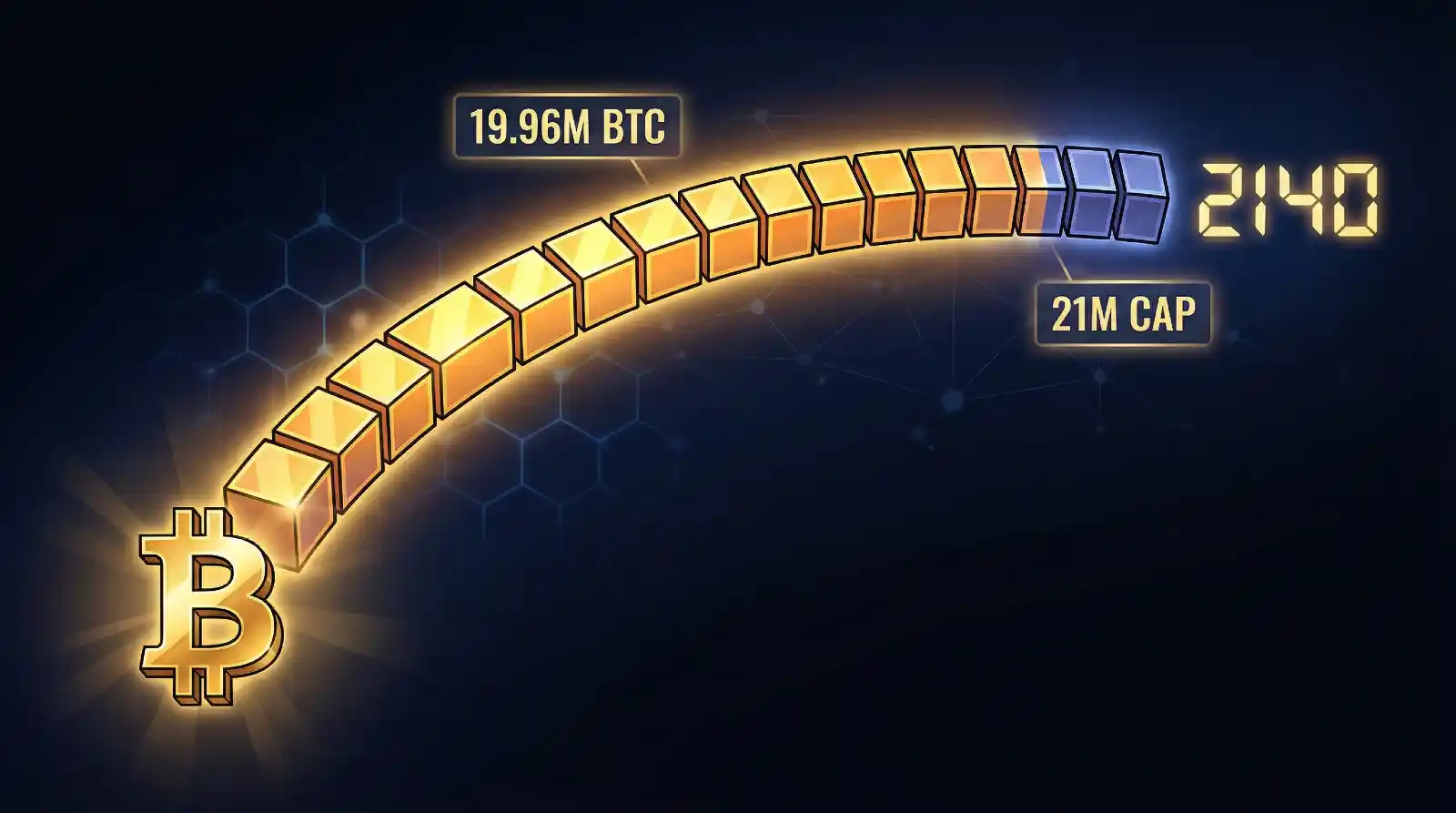
So what happens when all Bitcoin is mined? This question sparks significant debate in the cryptocurrency community. Bitcoin operates under fundamental constraints. That means there are only 21 million coins. According to the Bitcoin white paper, this hard cap intentionally creates digital scarcity.
As of December 2025, approximately 19.96 million BTC has already been mined. This represents approximately 95% of the total supply. As a result, the final Bitcoin will be mined around 2140, which raises important questions about the future of the network.
This article is for informational purposes only and does not constitute financial, investment or trading advice. Investing in cryptocurrency involves significant risk. Always conduct your own research and consult with a qualified financial advisor before making any investment decisions.
Why the 21 million limit?
Satoshi Nakamoto designed Bitcoin with a fixed supply to create predictable monetary policy. In contrast, central banks can print fiat currency without restrictions. As a result, the $21 million cap provides certainty that traditional money cannot provide.
This scarcity-conscious approach mirrors precious metals such as gold. However, Bitcoin’s supply schedule is completely transparent and mathematically predetermined. So anyone can see exactly how much Bitcoin they have left until all BTC has been mined. This transparency is critical to understanding the 2140 scenario.
When will the final Bitcoin be mined?
The halving mechanism determines when the last coin is created. Specifically, the block reward is halved approximately every four years.
When Bitcoin launched in 2009, miners earned 50 BTC per block. Then, after the April 2024 halving, the reward dropped to 3.125 BTC. This schedule will continue until the reward virtually reaches zero, around 2140, after the last Bitcoin has been mined.
There are currently approximately 450 new Bitcoins in circulation every day. However, this rate continues to decrease with each half-life event. As a result, new Bitcoin production will gradually decline in the 2030s and 2040s.
What happens when all Bitcoin is mined for miners?
Once block rewards disappear, miners will only rely on transaction fees. This means that all Bitcoin transaction fees are compensation for transaction verification.
Transaction fees currently account for a smaller portion of miners’ income. However, after the last Bitcoin has been mined, the only reward for securing the network becomes a fee. As a result, it remains unclear whether these fees will sustain robust operations.
Several factors will affect these results. Firstly, total trading volume is very important. Second, users’ willingness to pay fees plays an important role. Third, technological advancements can entirely impact transaction processing. Meanwhile, some analysts believe widespread adoption of Bitcoin could significantly increase fee revenues. Others, on the other hand, emphasize the difficulty of predicting the economy 100 years from now.
Will the network remain secure?
The security of Bitcoin depends on miners consuming computing resources. Basically, proof-of-work makes the cost of network attacks prohibitively high. However, once all BTC is mined, the dynamics of profitability change significantly.
Fortunately, economics automatically corrects itself. For example, if some miners leave, the difficulty level will be adjusted downward. These adjustments then make operations more profitable for the remaining participants. Additionally, Bitcoin has survived several periods of declining profitability before.
Nonetheless, the post-mining era brings significant uncertainty. In fact, predicting what will happen in 2140 requires a lot of guesswork. Moreover, the network may evolve in unexpected ways before the final Bitcoin is mined.
Can the 21 million limit change?
Technically, developers can modify the limit before all Bitcoins are mined. But doing so would require changes to Bitcoin’s core code and achieving overwhelming consensus. In particular, miners, node operators, developers, and users must all agree.
Such change faces enormous barriers. Above all else, fixed supply represents the most important characteristic of Bitcoin. Any proposals to increase supply will therefore face fierce resistance from holders. Eventually, existing coins lose value through dilution.
Additionally, Bitcoin’s decentralized governance makes coordinated changes difficult by design. Simply put, no central authority can unilaterally change the protocol. Historically, controversial changes have led to network fragmentation rather than universal adoption. Therefore, the 2140 scenario is likely to proceed as designed.
How do lost coins affect supply?
Not all 21 million Bitcoins are in circulation. According to Chainalysis, approximately 3 to 4 million BTC remains permanently lost. In reality, this represents approximately 14-19% of total supply.
Lost Bitcoins include coins with forgotten private keys, coins sent to invalid addresses, and dormant initial rewards. For example, notable examples include:
- Approximately 1 million BTC owned by Satoshi Nakamoto that has never been moved
- 8,000 BTC on James Howells’ hard drive abandoned in Welsh landfill
- More than 7,000 BTC were locked on Stefan Thomas’ IronKey device after he forgot his password.
Therefore, even after the last Bitcoin has been mined, the actual circulating supply remains well below 21 million. Likewise, the effective supply may continue to shrink as additional coins disappear due to user error, hardware failure, or death without a succession plan.
Conclusion: What happens when all the Bitcoin is mined?
In summary, the 2140 scenario marks an important transition. Bitcoin transitions from a block reward security to a transaction fee security. Ultimately, whether this transition goes smoothly depends on unpredictable factors.
What is certain is the basic design of Bitcoin. In other words, the Bitcoin supply limit defines the value proposition. Additionally, the protocol provides transparent and predictable monetary policy. Lastly, with 3 to 4 million coins already lost, the effective supply will remain well below the theoretical maximum.
The post-mining era ahead is one of the most discussed topics in cryptocurrency. As block rewards gradually decrease, the security of the network on fees alone will face the test. Understanding what happens when all Bitcoins are mined helps investors and enthusiasts prepare for this final transition.