
Hyperliquid’s Core Contributor Vesting Schedule is releasing another tranche of HYPE tokens this June, continuing the monthly unlock cycle that has been running on the 6th of every month since January 2026, and the cumulative size of these releases has now become too large for stakers, traders, and long-term holders to process as background noise.
The notional value of previous tranches exceeded $300 million, and with over 61% of the total 1 billion HYPE supply still locked as of mid-2026, the future release pipeline extends into 2027.
🚨 More than $975M is expected to hit the market this week (June 1-7). $HYPE leads the schedule with a massive unlock of $689.7 million on June 6, accounting for nearly 71% of all tokens unlocked during the week.
While the headline numbers may seem significant, the real impact may be much smaller… https://t.co/7ruPPYxFrN pic.twitter.com/wIECQwNH53
— Eazyscalp (@eazyscalp) June 4, 2026
The central tensions discussed in this article are: Each unlock simultaneously threatens short selling pressure and advances decentralized token distribution, making proof-of-stake networks like Hyperliquid’s L1 mainnet more resilient.
This unlock comes as HYPE trades around $59 after rising +36% over the past few months, falling 12% on the day and hitting all-time highs, including the current record of $75,48.
What Crypto Vesting Really Does and Why June Unlocks Are Not Just a Calendar Event
Cryptocurrency vesting is similar to a recruitment bonus paid in installments to encourage long-term commitment. For Hyperliquid’s early contributors, HYPE tokens will not be released all at once, but rather gradually over time.
Specifically, there is a one-year cliff followed by 24 months of linear vesting until 2027. Contributors received their first unlocks in January 2026 and approximately 1.2 million HYPEs were distributed.
The June unlock will occur within the same linear release window and will distribute approximately 237-238 million HYPE (about 23.8% of total supply) to core contributors.
This process is predictable and transparent on Hyperliquid’s L1 mainnet, as all token movements and activities are visible in real time. How contributors will later handle their tokens while they are scheduled to be unlocked is uncertain and may affect price and staking behavior.
Discover: Best new cryptocurrencies to invest in in 2026
Supply Math and Price Risk: What the Data Tells Us and What It Doesn’t
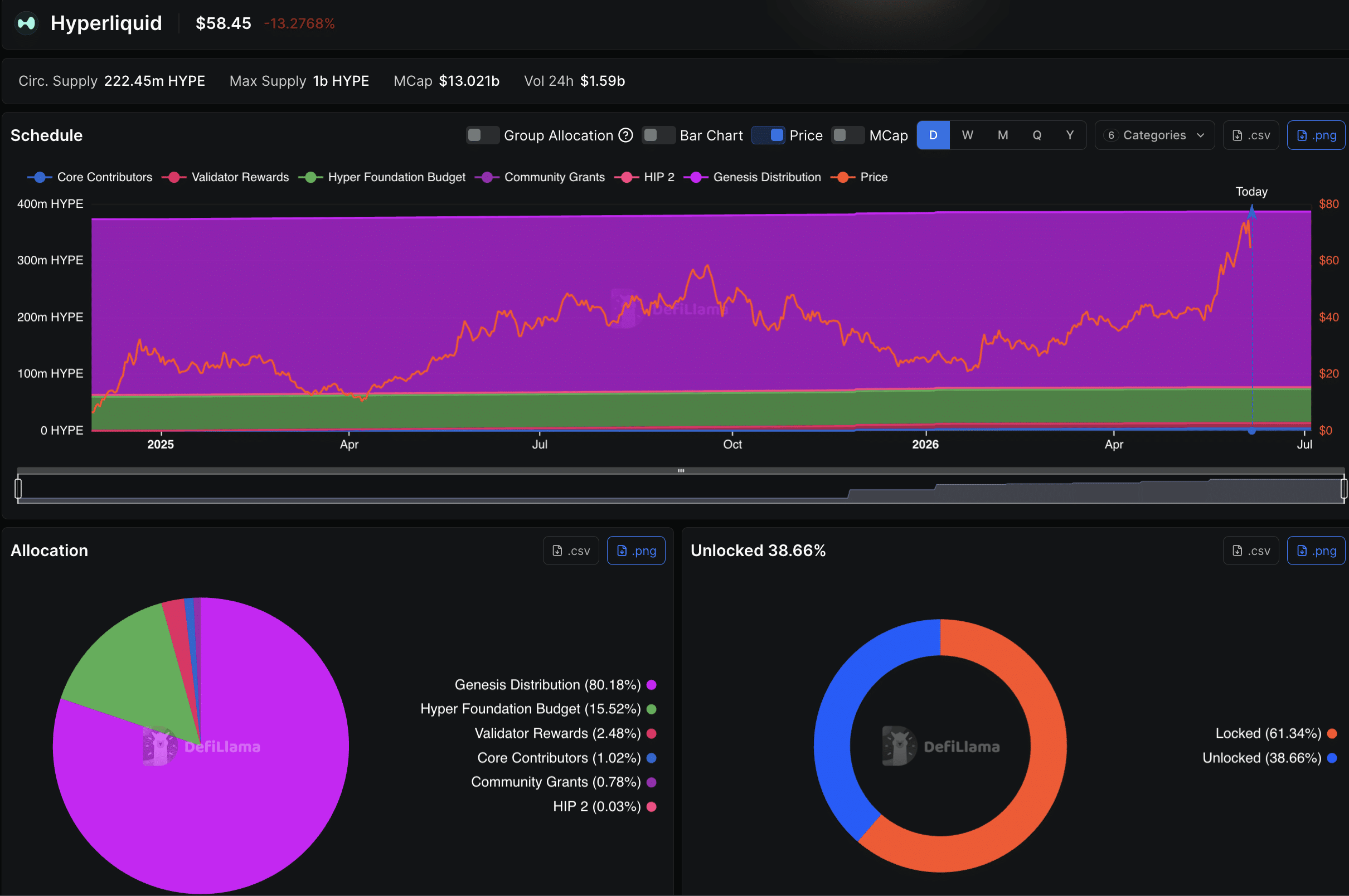
(Source: DefiLlama)
Data shows that there are approximately 238 million HYPE in circulation out of a maximum supply of 1 billion, with each monthly contributor tranche having a significant impact on the circulating supply.
For example, approximately 9.92 million HYPEs released in February 2026 accounted for approximately 2.7-2.8% of the circulating supply. A similar launch is expected in June, with a market capitalization estimated at between $6.2 billion and $8.6 billion.
However, the size of unlocks alone does not determine price direction. Hyperliquid’s strong trading volume and ample liquidity (often between $500 million and $1 billion in TVL) help it absorb selling pressure from unlock events.
When daily volume is relatively high, the market can handle larger sales without significant price drops. The effect is more severe at lower volumes.
Three scenarios could unfold in June:
Fire case: Most unlocked tokens are re-staked or held to prevent oversupply. HYPE prices stabilize or rise thanks to platform fee revenue.
Base case: About 20-40% of the tranches are sold, resulting in a 5-15% drop, but the market rebounds within 2-3 weeks as demand returns to lower prices.
Bear case: A coordinated sell-off coupled with widespread market weakness leads to a sharp correction. Negative sentiment may amplify this, but if exchange inflows remain low even after the unlocks, the bearish scenario is nullified.
A key factor in determining the outcome is the staking behavior of contributors within 48 hours of unlocking. Re-staking indicates long-term trust, while exchange deposits indicate selling intent. Both actions are observable on-chain.
Exclusive: Get $10 USDC when you sign up for Binance
How the June Lockdown Really Affects Rewards Staking on Hyperliquid
This section is for anyone currently staking or considering HYPE, including validators. Staking returns can be understood as dividends from a shared pool. While the pool size remains constant, as more people claim it, each stake decreases, creating a risk of dilution with each token unlocked.
Staking revenue on Hyperliquid’s L1 mainnet primarily comes from transaction fees on HyperCore, which manages up to 200,000 orders per second. Unlike proof-of-work networks that rely on the issuance of new tokens, Hyperliquid’s rewards are tightly tied to platform activity, partially decoupling staking APR from supply expansion.
Staking unlocked tokens increases the total staked supply, which may reduce your individual APR unless it increases your fee income. Conversely, when tokens are sold, circulating supply increases, influencing the price but reducing dilution to existing stakers.
Both outcomes are problematic, but given the consistent fee income and growing institutional profile of the platform, moderate yield compression is more likely in the near term. Stakers should adjust their expectations to a gradually normalizing return environment that reflects network maturity rather than crisis.
Explore: Best Meme Coin ICOs to Invest in in 2026

Why you can trust 99Bitcoins
Founded in 2013, 99Bitcoin’s team members have been cryptocurrency experts since the early days of Bitcoin.
90 hours or more
weekly study
100,000+
monthly reader
50+
expert contributor
2000+
Cryptocurrency Projects Reviewed


Follow 99Bitcoins in your Google News Feed.
Get the latest updates, trends and insights right at your fingertips. Subscribe now!
Subscribe Now